

Vill du ha ett snabbt svar - sök i databasen
621 frågor / svar hittades
Klimatändringar orsakade av jordaxelns lutning
Hej!
Om jordens lutning ökar till 90 grader vad händer då? Undrar samma vad som händer om lutningen minskar till 0 grader?
/Catharina T, Liu, Norrköping 2015-11-04
Jordaxelns lutning varierar mellan 22 och 25 grader mot jordbanan. Det är antagligen månen som har en stabiliserande verkan, se fråga
[19119].
Lutningen påverkar klimatet en del. Om lutningen ökar blir det varmare, om den minskar blir det kallare, se fråga [14214]. För extrema ändringar i lutningen (till 90 eller 0 grader) skulle vi få extrema klimatförändringar. 0 grader skulle ge stora istäckta polarområden. 90 grader skulle betyda att all is smälter på sommaren så att inga varaktiga istäcken alls kan bildas. Istäcken ger högre reflektion av solstrålningen och alltså lägre temperatur.
Se även fråga [14214].
/Peter E 2015-11-04
Fossila bränslen och koldioxid i jordens atmosfär
Hej!
Det tycks mig som om temperaturen på jorden under karbontiden, ett antal miljoner år, sjönk kontinuerligt, och detta trots att istider bör ha funnits även då. Har det att göra med att växter tog upp kol ur atmosfären och lagrade den i form av kol och olja, vilka nu under kort tid tas upp och släpps ut igen?
/Thomas Ã, Knivsta 2015-11-05
I fråga [19940] finns jordens medeltemperatur de senaste 500 miljoner åren. Temperaturen var alltså 10-15 grader varmare vid 300-500 Ma (mega annum) och i Karbon (omkring 100 Ma). Detta beror säkert till en stor del på att koldioxidhalten var mycket högre då, se nedanstående figur från
Halten koldioxid i atmosfären ges av en balans mellan förbrukning i fotosyntes i växter, kontinentaldriftens transport av kol till jordens inre (se fråga [17321]), förruttnelse och utsläpp av koldioxid från vulkanism.
Landväxter etablerade sig för c:a 400 Ma sedan. En del av dessa liksom havsväxter har säkert begravts och förvandlats till fossila bränslen (se fråga [1782]). Detta förklarar säkert åtminstone till en del den stora nergången i koldioxidhalten omkring 400 Ma (Karbon, Karbon
 ) och runt 100 Ma (Krita, Krita_(geologi)).
Se vidare

Varför knastrar vatten som värms, t.ex. i en tekokare?
Varför dundrar vatten som värms, t.ex. i en tekokare? Detta ljud kommer ju nästan direkt och innan några synbara bubblor bildats
/Jan S, Centralskolan, Ekshärad 2016-02-11
Bra fråga Jan (som man säger när man inte vet svaret). Här är hur det låter:
Det finns ett antal olika förklaringar på nätet, den ena dummare än den andra. Jag är rätt säker på att den första förklaringen i länk 1 är den korrekta:
Chris Smith: Ah, yes my kettle is no exception and the reason that kettles are noisy, they make that sort of thumping and bashing noise as they boil and then the noise intensifies as they warm up and then it goes silent as they boil.
It is because of the way that the heat is being transferred into the water. So you have an electric element inside the kettle, a high current is passing through that element which makes it get hot. The heat from the element is therefore transferred by convection and conduction locally onto the water molecules around the element; they then get excited and get hot. So you have a bubble of hot water around the element which tries to expand and it also floats upwards away from the element because, of course, warm things rise but as it rises of course it loses its heat again to all of the surrounding water. So this bubble of water and water vapour collapses in on itself very quickly and that’s cavitation and you get a shocking, sort of knocking noise. So those thumps that you hear and the sort of ‘shhh’ hissing that you hear, as the water vapour bubbles collapsing on themselves and emitting some sound waves, that’s what the sound is.
Värmeelementet blir snabbt mycket varmt. Det bildas då mycket små bubblor som stiger - gas är lättare än vatten. Bubblorna försvinner emellertid mycket snabbt, eftersom vattnet fortfarande är ganska kallt, och kollapsar. Det är kollapsen av bubblorna som ger det knastrande ljudet.
Jag kollade teorin med min vattenkokare. Bubblorna är mycket små men de syns tydligt med belysning från en ficklampa. Man hör ljudet så snart bubblorna börjar bildas.
För en kärnfysiker är det knastrande ljudet bekant: det låter som ett GM-rör med ett radioaktivt preparat - speciellt i början när det bildas få bubblor. Hur kan det komma sig?
Bildandet av en bubbla är liksom sönderfallet av en radioaktiv kärna en slumpmässig process. Antalet bildade bubblor (sönderfallande kärnor) per sekund är poissonfördelat, se fråga [16653]. Se även
Här är ett stöd för den föreslagna förklaringen (från länk 2):
Long before the bulk of the water in your teapot hits 100°C, the bottom of the pot will be heated to over the boiling temperature of water. Water in contact with it will briefly flash into steam, but the resulting small bubbles will quickly collapse as they transfer their heat to the surrounding cooler water. If the bubbles are small enough (have a large surface to volume ratio), the collapse can be fast enough to make a popping or sizzling sound. This can happen even when the bubbles are too small for you to see.
/Peter E 2016-02-12
Kunskapsmål i fysik
Jag är lite nyfiken på hur ni experter inom fysik skulle tolka följande textrad hämtad ur LGR11, kunskapsmålen i fysik för åk 6:
"Dessutom förklarar eleven och visar på mönster i himlakroppars rörelse i förhållande till varandra..."
Det är ett kriterium för betyget A. Det som skiljer målen för A från kunskapsmålet på nivå C (som är lägre) är att då behöver eleven istället för att se mönster i rörelserna visa på samband kring himlakroppars rörelse i förhållande till varandra.
Jag har undervisat eleverna i min åk 5 om hur bl.a. planeterna rör sig runt solen och hur månar rör sig kring planeter. Vi har pratat om att gravitationen håller planeter och månar i sina omloppsbanor och att gravitationen påverkar kroppar som är nära mer än kroppar som befinner sig långt ifrån. Vi har pratat om att det är anledningen till att planeterna närmast solen rör sig snabbare i sina omloppsbanor jämfört med planeterna längre bort.
Generaliseringen som vi gjort är att himlakroppar med större massa och gravitation håller kroppar med mindre massa och gravitation i omloppsbana istället för tvärtom. Men vi har också resonerat om att de mindre kropparna också drar i de större och skapar en "wobblande" rörelse hos dem.
Hur tolkar ni skillnaden mellan att se mönster och se samband kring himlakropparnas rörelser. Är det något som jag borde ta upp mer med mina elever för att komma ner på det djup som kunskapsmålet riktar in sig på?
Med vänlig hälsning
Petri Matalamaa
/Petri M, Paulinska skolan, Strängnäs 2016-02-24
Hej Petri! Jag håller i stort med om kunskapsmålen och tycker det låter som att du uppfattat dem mycket bra.
För det första är jag allergisk mot begreppet förklara när det gäller fysikens lagar. Förklara är för mig svar på frågan varför?. I djupare mening vet vi inte varför naturlagarna är som de är, se fråga [12126].
Fysik är en empirisk vetenskap som i grunden bygger på observationer och experiment, se fråga [14232]. Fysiken använder matematik som ett verktyg, men fysik är inte matematik. Ofta utgår man från ett antagande och detta antagande kan sedan få stöd genom direkta eller indirekta observationer. Einstein antog t.ex. att ljushasigheten i vakuum är konstant när han utvecklade sin speciella relativitetsteori, och denna har visat sig stämma mycket väl.
Från Tycho Brahes mycket exakta mätningar av planeten Mars' rörelse (slutet av 1500-talet) kunde Johannes Kepler (i början av 1600-talet) få fram tre lagar för planeternas rörelser. Samtidigt använde Gallileo Gallilei det nyuppfunna teleskopet för att göra astronomiska observationer. Han studerade även, både teoretiskt och experimentellt, kroppars rörelse.
Isaac Newton kunde senare (andra hälften av 1600-talet) "förklara" planeternas rörelser med hjälp av en lag, den universella gravitationslagen och nyutvecklad matematik (differentialkalkyl).
Den ovanstående utgör det centrala i utvecklingen av den moderna vetenskapliga metod som används i naturvetenskapen, se fråga [14237].
En annan viktig aspekt på fysik är att fysikaliska lagar inte är huggna i sten, utan de kan modifieras allteftersom vi gör bättre observationer.
Lagarna kan emellertid inte ändras hur fritt som helst, utan de måste alltid kunna reproducera alla befintliga mätresultat. Einsteins allmänna relativitetsteori beskriver gravitationen på ett utmärkt sätt, men den är mycket olik Newtons gravitationsteori. Det betyder inte att Newton hade fel, bara att det fanns begränsningar i giltigheten. Man använder t.ex. forfarande Newtons teori för att beräkna banor för rymdsonder.
I fysik använder man sig ofta av förenklade modeller som beskriver ett fysikaliskt fenomen med begränsade förutsättningar, se fråga [18296]. I kärnfysik betraktar man t.ex. ibland atomkärnan som en vätskedroppe och ibland som nukleoner som rör sig fritt i en potential (skalmodell). Modellerna är egentligen helt inkompatibla, men de är ändå av värde eftersom de båda "förklarar" olika egenskaper hos atomkärnor.
Och nu äntligen till din fråga:
Begreppet "förklarar" i texten ovan får man tolka så att man kan beskriva ett fenomen på en djupare nivå. Låt oss ta solens rörelse. Den dagliga rörelsen från öster till väster "förklaras" av att jorden roterar kring sin axel.
Solen rör sig även lite från väster till öster i förhållande till de avlägsna stjärnorna. Detta "förklaras" av att jorden rör sig ett varv runt solen på ett år. För att få ett A måste vi även kunna beskriva att den årliga rörelsen beskrivs av Newtons gravitationslag.
Den "wobblande" rörelsen du talar om uppkommer eftersom två kroppar rör sig i elliptiska banor kring den gemensamma tyngdpunkten. Om mass-skillnaden mellan kropparna är stor ligger den gemensamma tyngdpunkten nära den tyngre kroppens centrum. Detta betyder att den tyngre kroppen rör sig mycket lite.
Ett annat exempel är solsystemets uppbyggnad. Vi kan observera att planeterna alla rör sig åt samma håll och i ett plan. Detta kan "förklaras" genom modellen att solsystemet bildats genom att ett gasmoln dras samman av gravitationen. Bevarande av rörelsemängdsmomentet (se fråga [12527]) ger då upphov till en roterande skiva av gas och stoft. Denna bildar sedan planeterna i ett plan och rörelse åt samma håll.
I fråga [16776] beskrivs solsystemets rörelse i vintergatan och universum.
/Peter E 2016-02-24
Konspirationsteori: månlandningen har aldrig ägt rum
Kan en flagga vaja när den är på månen?
Om flaggan utsätts för en kraft så den rör sig, kommer den att röra sig i all evighet?
Eftersom månen snurrar kan den påverka flaggan?
Frågorna kommer från undringar om månlandningen och olika konspirationsteorier där man inte tror på månlandningen eftersom flaggan vajade.
/Minna S, Vux i Kungälv, Kungälv 2016-10-21
Ja, flaggan kan vaja om den eller flaggstången störs. Det behövs alltså ingen vind utan flaggan utför en pendelrörelse. På grund av friktion kommer rörelsen att upphöra efter ett tag. Nej, månens rotation påverkar inte flaggans rörelse.
Problemet med alla sådana här fåniga konspirationsteorier är att man väljer ut en sak som kan tyckas vara svår att förklara, medan man bortser från alla andra mycket starka bevis för att konspirationsteorin är falsk. Man landade ju faktiskt på månen sex gånger med Apollo 11, 12, 14, 15, 16 och 17 med direktsändning i TV till hela världen. Ytterligare en svaghet med många konspirationsteorier är komplexiteten och antalet människor som måste vara involverade. Som vanligt gäller (Occam’s Razor): den enklaste förklaringen är oftast den korrekta.
Starten på månlandaren till Apollo 17 är ganska övertygande:
Se även fråga [12483] och
PS. Vem var det som stannade kvar på månen och riktade om kameran? :-)
/Peter E 2016-10-21
Varför blir vindarna runt ett lågtryck högre än de runt ett högtryck?
Varför blir vindarna runt ett lågtryck högre än de runt ett högtryck? Alla ger mig bara svaret att det är så men inte varför. Ett invecklat svar gör mig inget, sådana gillar jag. Jag har aldrig stött på något som är för svårt, hade gärna bockat i gymnasium, men jag går bara i 7:an. Vore tacksam för svar. Men vänliga hälsningar Elina.
/Elina H, Irstaskolan, Västerås 2016-12-15
Hej Elina! Bra att du har höga ambitioner! Det är en meteorologifråga, så vi är inte experter (även om vi numera utbildar meteorologer i Lund), så du får ett fysikersvar. För övrigt är meteorologer också fysiker - säkert den variant som syns mest i samhället.
Det behöver inte alltid vara så att vindarna är starkare i ett lågtryck, även om det oftast är så. Det är emellertid utan tvekan så att de starkaste vindarna uppstår i en sorts lågtryck (orkaner).
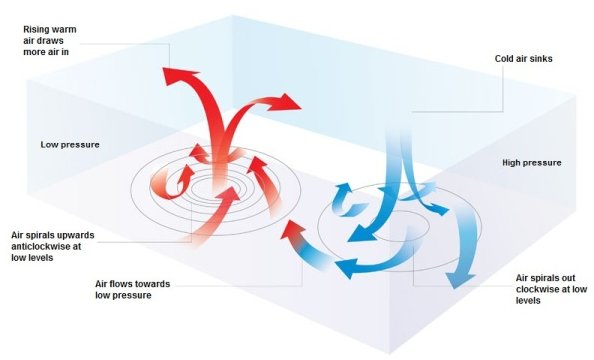
I ett högtryck (anticyklon) tenderar vinden vara svag och blåsa medurs (på norra halvklotet), se nedanstående bild från länk 1. Luften transporteras nedåt, varför den blir varmare. Detta reducerar sannolikheten för att moln skall bildas, vi får svaga vindar, inga moln och stabilt väder.
I ett lågtryck stiger luften och blåser moturs (på norra halvklotet) omkring lågtrycket. När luftmassan stiger kyls den och kondenserar och bildar moln. Detta är anledningen till att lågtryck ger ostadigt väder med nederbörd.
Anledningen till att luften inte går rakt från högt till lågt lufttryck är jordens rotation och Coriolis-kraften, se fråga
[17487].
Att flytta luft som beskrives ovan kostar energi. Var kommer denna energi ifrån? Låt oss titta på ett extremt lågtryck, en tropisk orkan (se Tropisk_cyklon
) för att förstå drivmekanismen. En orkan uppstår ovanför en varm vattenyta (minst 26,5 °C). Vattnet värmer luften och en del av vattenmolekylerna avdunstar. Eftersom varm luft har lägre densitet än kall luft så stiger luften. Då trycket minskar med höjden avkyls luften varvid vattenångan kondenseras till moln. När vattenånga kondenseras till vattendroppar frigörs energi (ångbildningsvärme, se fråga [14203]). Luften värms upp och fortsätter stiga. Värmen från solen värmer alltså vattenytan och den stigande vattenångan transporterar värmet uppåt. Om det finns tillräckligt med vattenånga och värme kan denna process bli mycket våldsam, och vi har en tropisk cyklon som i varma delar av Atlanten kallas orkan.
Vanliga lågtryck på våra breddgrader (och över land) uppstår och drivs på liknande sätt som orkaner, skillnaden är att energimängden bara räcker för att bilda en "mini-orkan" - ett lågtryck.
Se vidare länk 1 och 2.
Fysikaliska teorier och experimentella resultat
"Fysik är en empirisk vetenskap som i grunden bygger på observationer och experiment"
Hej detta citat finner jag klart intressant. Särskilt då flertalet forskare jag stött på enbart lutar sig mot gällande teorier och inte bryr sig ett dugg om empiri. Vid flera tillfällen har jag lagt fram försök och bett om en förklaring och bara fått svaret "det går inte". Forskare verkar vara en ängslig grupp som måste hålla sig inom ett visst litet område.?
/zacharias b, Stockholm 2017-05-03
Jo, fysik är visst en empirisk vetenskap! Utan stöd i experiment och observationer är en teori meningslös. Vi har diskuterat detta i massor av frågor, se t.ex. fråga [20136].
I själva verket är vår förståelse mycket grund -- vi förstår inget om varför fysikens lagar är som de är. Däremot är resultatet av försök oftast mycket väl beskrivna av fysikaliska teorier, se t.ex. fråga [19591], där den mycket respekterade fysikern Richard Feynman lätt irriterad svarar att han egentligen inte begriper magnetisk kraftverkan.
Det var konstiga forskare du konsulterat om dom verkligen menar att de inte bryr sig om empiri. Dels använder de sig av gällande teorier och dels kan dom inte förklara någonting.
Jag tror du missförstått vad de säger. För det första är många lagar så etablerade att vi knappast behöver bekymra oss om resultat av experiment. Om vi släpper en boll från handen faller bollen till marken, det vet vi. Sedan tror jag att forskarna menat att de inte kan svara på frågan varför. Däremot kan vi oftast med fysikaliska teorier beskriva hur mycket väl.
Du säger inte vilka experiment du bett forskare förklara. Har det varit resultat som strider mot en mycket väletablerad lag? I så fall behöver man mycket starka bevis och bevisbördan ligger hos den som påstår avvikelsen. Ett klassiskt exempel är evighetsmaskiner som strider mot de mycket etablerade termodynamikens huvudsatser, se fråga [15733].
Se fråga [14237] för mer om vetenskaplig metod.
/Peter E 2017-05-03
Tidens riktning
Hej!
Tiden går endast åt ett håll, om den går, sägs det, och entropiökningen lär vara ett tecken på det. I en åratalsgammal odaterad tidningsnotis sägs det att kaonernas sönderfall/förändringar också är ett tecken på tidspilens riktning, enligt CERN.
Finns det fler i fysiken fastställda tecken på tidens enkelriktning?
/Thomas Ã, Knivsta 2020-05-03
Thomas! Detta är en svår fråga. Det är till och med så att det är ett av fysikens olösta problem, se
Svenska Wikipedia säger: om
Vad är det för skillnad på framåt och bakåt i tiden? Varför upplever vi olika riktningar i tiden som väsensskilda, men inte olika riktningar i rummet? Varför är de flesta, men inte alla, naturlagar tidssymmetriska? Vilken relation har detta till CP-brott och termodynamikens andra huvudsats? Finns det undantag till lagen om kausalitet? Är det förflutna unikt, eller finns det flera förflutna? Framtiden? (Fysikens_olösta_problem
)Ja, det finns andra fenomen som eventuellt kan definiera en tidspil, se
.Se även fråga [1298] och [19290].
/Peter E 2020-05-04
Vad händer när de flesta gaser löser sig i vattnet i atmosfären?
Vad händer när de flesta gaser (och avgaser) löser sig i vattnet i atmosfären? eller det det kanske är kemi
/Olivia l, kungsholmens grundskola, stockholm 2021-05-01
Olivia!
Ja, det är kemi, men vi kan ändå säga lite.
Vatten i atmosfären förekommer som vattenånga ([21208]) som består av fria molekyler av vatten. En del av vattnet i atmosfären förekommer som små vattendroppar med många namn, t.ex. moln, dimma, dis.
För att vattendroppar skall bildas behövs kondensationskärnor i form av små partiklar (aerosoler), se fråga [15136]. Så förekomsten av aerosoler är viktig för atmosfärkemin.
Vad gäller om gaser löser sig i vattnet så beror det på vilken gas det rör sig om. Gaser som SO2 och NOx kan lösas upp i vattendropparna och orsaka surt regn (se Surt_regn
) som kan orsaka skador på djur och växter./Peter E 2021-05-01
Mer regn på västkusten?
Om man tänker i metrologi varför regnar det mer på västkusten än ostkusten?
/Bella F, Landsbro skola, Landsbro 2026-04-01
Vindarna blåser oftast från väster. Detta beror främst på jordens rotation och tryckskillnader mellan ekvator och poler.
Fuktig luft från Atlanten blåser då in över västkusten. När luften möter höjderna längs västkusten och Skandinaviska fjällkedjan tvingas den uppåt. Temperaturen avtar med höjden så luften kyls. Kall luft kan inte hålla lika mycket vattenånga, som då kondenseras till vattendroppar som vi ser som moln. Fortsätter luften uppåt blir dropparna så stora att det faller som regn. Detta är samma process som gör att marken blir våt av dagg när luften kyls på kvällen.
På östsidan har luften redan tappat mycket fukt och det blir torrare med en så kallad regnskugga.
Se även Orografisk_nederbörd
/Lars 2026-04-01
Länkar till externa sidor kan inte garanteras bibehålla informationen som fanns vid tillfället när frågan besvarades.

Denna sida från NRCF är licensierad under Creative Commons: Erkännande-Ickekommersiell-Inga bearbetningar